After the Ban Soc ceremony, the royal court performs the Phat Thuc ritual, involving the cleaning and tidying of the palace, throne, jade seal, and precious artifacts in preparation for the upcoming year. The palace maids conclude the year by washing and ironing their robes and applying makeup in anticipation of the new year. Following the Phat Thuc ritual, all government offices and subordinates take a break for the Tet holiday. On the 30th day of Tet, the Royal Calendar Office selects an auspicious hour to erect the Neu tree. Once the court's Neu tree is set up, the general public is allowed to raise their own Neu trees to celebrate Tet.
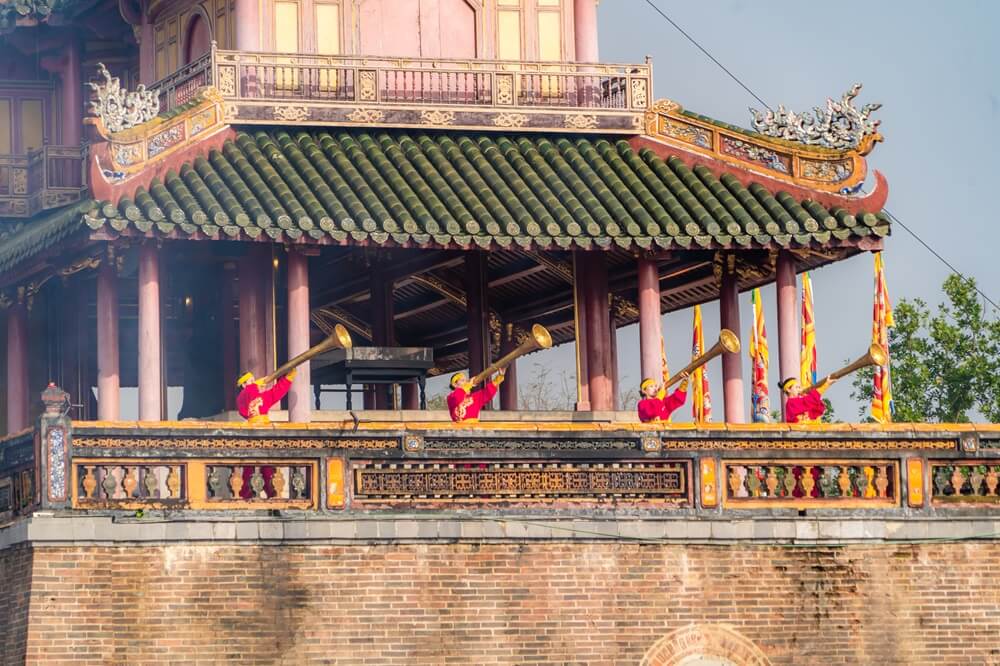
The official Lunar New Year ceremony takes place on the first day of the year. On this day, military personnel in the court, adorned with weapons, flags, and decorated elephants and horses, line up from Thai Hoa Palace towards Ngọ Môn gate. The king, dressed in royal attire, proceeds from Cần Chánh Palace to Thai Hoa Palace and ascends the golden throne to receive the congratulations of officials and close associates. The Five Phoenix Pavilion resonates with the sound of bells and drums.
Following the festive days of welcoming Tet, the royal court organizes the Tich Dien ceremony, a symbolic plowing ritual, seeking a successful agricultural year. The king, dressed in ceremonial attire and adorned with a headband, carries a plow and leads two oxen covered in golden silk. The king plows the first furrows in a field within the capital, accompanied by officials from the Thua Thien precinct.
Hue People Celebrating Tet
The people of Hue celebrate Tet with a unique blend of traditional and royal values, as the region was the last imperial capital under the feudal system. Their refined culture is reflected in elaborate rituals that pay homage to deities, ancestors, and elders, showcasing rich cultural and humanitarian aspects.
The Tet celebration in Hue extends well beyond the typical three-day period, seemingly spanning from the end of the lunar month of Chạp to the middle of Giêng. The local customs of Tet in Hue are perhaps the most extensive compared to other regions in the country.
Starting around the 20th day of the lunar month, the preparation for Tet begins with cleaning homes, tidying ancestral altars, changing incense, and candles, and placing white sand in incense burners to invite ancestors for a family reunion. For the people of Hue, Tet is a time not only for the living but also for remembering and honoring the departed.
One of the first ceremonies in the last days of Chạp is the ritual of sending the Kitchen God, Ông Táo, back to the heavens. The ceremony involves simple offerings, including betel leaves, areca nuts, rice wine, paper money (symbolizing gold coins), and most importantly, clay statues of the Kitchen God (consisting of one goddess and two gods). Nowadays, it is uncommon to see the inclusion of live carp in the farewell ceremony in Hue.
Folk beliefs hold that the Kitchen God oversees the rice bowls of each family, hence his regular presence and complete understanding of the lives of people in the mortal realm. On the 23rd day of Chạp, the Kitchen God concludes his mission and returns to the heavens, making way for a new set of Kitchen Gods to take up their responsibilities. The Kitchen God reports on the lives of people to the Jade Emperor, advocating for policies such as "eradicating hunger and reducing poverty" by granting peace, health, and favorable weather to every family in the coming year. Therefore, during the farewell ceremony, families in Hue must prepare offerings for the Kitchen God's journey to the heavens and present a report to the Emperor of Heaven."
From the 20th to the 30th day of the lunar month of January, it is the time for families to conduct year-end rituals. The Tet year-end rituals in Hue serve two purposes: expressing gratitude to the ancestral trade deities for providing sustenance and reflecting on a year of hard work. Each trade selects a characteristic offering for the ritual, but regardless of the profession, offerings typically include betel leaves, areca nuts, rice wine, sticky rice, chicken thighs (with the drumstick intact), incense, and fruits.
Following this is the ceremony to invite and honor grandparents (usually conducted on the afternoon of the 30th day of Tet). The year-end feast for grandparents signifies the descendants preparing offerings to invite ancestors, grandparents, parents, and others who have passed away to come back and reunite with the family. The offerings vary based on each family's economic conditions, with wealthier families preparing elaborate meals while those with fewer resources may offer simpler dishes like stir-fried vegetables and a few meat dishes, similar to the offerings during the annual commemoration of deceased relatives.
At the moment of transition from the old year to the new year, precisely at midnight on the first day of Tet, every household must perform the ritual to welcome the New Year. This ceremony signifies bidding farewell to the ruling deity of the old year and welcoming the new one (there are 12 ruling deities corresponding to each zodiac animal for the respective years). Offerings for the New Year ritual include incense, gold, betel leaves, areca nuts, rice wine, a tray of five fruits, the attire and belt of the ruling deity, candied fruits, boiled chicken (sometimes using a pig's head), and Tet cakes (either cylindrical or square). The key principle of the New Year ritual is to prepare offerings in advance and conduct the ceremony right at the transition moment, without any delay.
The New Year ritual also marks the official beginning of Tet. Since the majority of the people in Hue follow Buddhism, the first day of Tet is often observed with vegetarian meals and visits to temples to pay respects to Buddha. Starting from the second day of Tet, families begin visiting and exchanging Tet wishes with relatives, extended family, and friends. During these days, whatever dish a family decides to eat must be placed on the ancestral altar beforehand to invite the ancestors to join in the celebration.
Signature Tet dishes in Hue, rich in flavors, include nem (fermented pork rolls), tre (fermented shrimp rolls), cha (pork sausage), nem lui (grilled minced pork on lemongrass sticks), beef soaked in fish sauce (or soy sauce), shredded meat, and various items rolled in rice paper, served with pickled vegetables. Main courses accompanying rice during Tet often feature roasted and fried items like pork ribs and chicken. Cooked dishes may include braised beef, simmered pork and turnip, braised lean meat, clam soup, and simmered chicken. Tet would not be complete without the traditional banh tet, served with pickled vegetables.
Hue and the Central region, in general, are known for a variety of desserts, such as ginger jam, sweet potato jam, sugarcane sticks (also called "bamboo sticks"), molded cakes, rectangular cakes, cassava cakes, sticky rice cakes, and green bean cakes, among others.
Celebrating Spring in Hue
From the 25th day of the lunar month of Chạp, the Spring Flower Festival in Hue kicks off, with artisans displaying their most beautiful flowers throughout the imperial city. At this time, Phu Van Lau is vibrant with myriad species of flowers. Here, some pots of apricot blossoms, hundreds of years old, are showcased by their owners merely for admiration, never for sale. In recent years, Hue's Spring Flower Market has also featured various types of lantern flowers, bougainvillea, roses, etc., originating from the misty Bach Ma region.
Looking from Phu Van Lau towards the Imperial City, the city is aglow with the colors of flowers. In front of the Spring Flower Market, the Perfume River flows serenely in the morning mist. During each sunset, if it's not raining, the fading sunlight reflecting on the Perfume River creates a dreamy purple hue, captivating the hearts of onlookers.
The Perfume River becomes even more lively on Tet days with the traditional boat racing festival, attracting renowned rowers from the ancient capital's rivers and waters.
If one has the opportunity to celebrate Tet in Hue, one should visit the village of Sinh, Phu Mau commune, Phu Vang district, to witness the traditional martial arts festival on the 10th day of the first lunar month. All the agile and strongest young men participate in the wrestling arena, pouring sweat as they compete with superior martial spirit. Local girls dress beautifully to cheer for the village men competing, showcasing the strength and vigor of the male contestants. The festival lasts for an entire day, and the cheers echo throughout the village.
In addition to the wrestling festival in Sinh village, there is also the martial arts festival in Thu Le village (Quang Phu commune, Quang Dien district) on the fourth day of Tet; the straw hat festival in Thanh Toan Tile Bridge and the rural market on Tet days in My Loi village. Especially, in the rural market in Gia Lac on National Highway 49A (from Hue to Thuan An), during Tet, the local people bring out many traditional handmade products for sale, including the special to him, a favorite of every child due to the shapes of clay-molded birds, producing delightful sounds when blown.
Traditional folk games in Hue are still preserved in rural villages, such as the straw hat festival (known as Bai Toi in Hue), often organized at rural markets and village communal houses; children gathering around crab baskets, elderly people sitting by the warm coal stove playing a game of boc lu (with 32 copper coins), and elders engaging in strategic battles with Chinese chess (also known as co vay), and gambling with colored dice.
In this way, over time, the Lunar New Year in ancient Hue, with its deep-rooted traditions, maintains a distinct flavor that is not easily found elsewhere.