A Cultural Highlight of Hue Festival 2026
The program was a centerpiece of Hue Festival 2026 and Hue Poetry Day, enriching the "Hue Spring Festival" (Xuan Co Do) series. By bringing royal literature to a public stage, the organizers aimed to spread the profound values of imperial poetry to locals and international tourists alike.
The poetic legacy of the Nguyen emperors is a unique hallmark in the flow of Vietnamese literature. Beyond being heads of state, the kings were renowned Confucian scholars who left behind a massive volume of works rich in ideological value. For these emperors, poetry was the very "breath" of their political and cultural life.
Historical Milestone:
-
King Minh Mang: Approximately 4,200 imperial poems.
-
King Thieu Tri: Approximately 3,700 poems.
-
King Tu Duc: Approximately 4,600 poems.
-
Kings Dong Khanh, Thanh Thai, and Khai Định also left behind significant Han script compositions.
Through the royal brush, poetry became a vessel for the "will of the state and the heart of the people"—embodying the concept of "Ngôn Chí" (Poetry to express one's spirit), a defining characteristic of medieval literature.

An Epic Journey Through 10 Seamless Chapters
“Thi Di Ngon Chi” was an elaborately staged production using epic storytelling to depict the social landscape of 19th-century Vietnam in the Hue Citadel. The program unfolded through 10 interconnected chapters:
-
Royal Spring Harmony: The monarch’s reflections on the essence of spring.
-
Spring Festivals & Spring Military Review: Recreating the court’s vitality and the spirit of national protection.
-
Joyful Harvest & Flavors of Common Life: Bringing the breath of the people's prosperity into royal verse.
-
Royal Poetry Exchanges & Capital Landscapes: Portraying the cultural beauty of the ancient capital.
-
Building Prosperity (Thai Hoa), Eternal Treasures, and Radiant Spring: A closing symphony celebrating a flourishing society.
From solemn court rituals to the simple life of the peasantry, and from the sacred soul of the mountains to thousand-year-old treasures, the program transformed 19th-century Hue into a vivid, multi-dimensional reality.
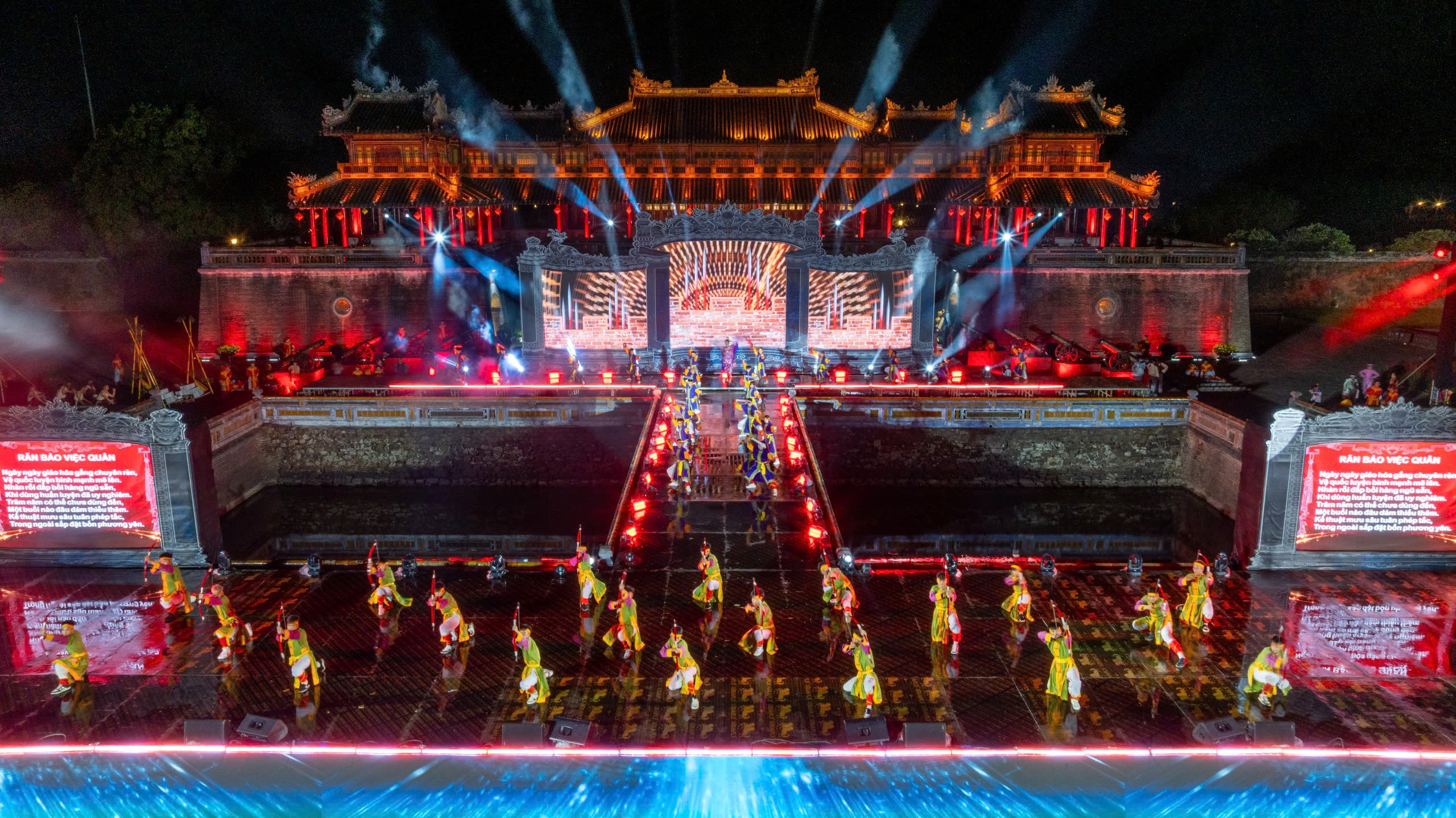
A Symphony of Light, Sound, and History
The poems were woven into an allegorical narrative, harmoniously combining:
-
Modern Stage Visuals: Advanced lighting and soundscapes.
-
Theatrical Performance: Realistic acting and traditional choreography.
-
Special Effects: Pyrotechnics and smoke effects creating a highly emotional and immersive atmosphere.
Each verse served as a historical slice, and every movement on stage acted as a cultural pulse. “Thi Di Ngon Chi” successfully honored the depth of Hue’s imperial literature, proving that the poetic legacy of the Nguyen Dynasty remains a radiant treasure in the flow of time.