All surviving mirror paintings of significance today are legacies of the Nguyen Dynasty. These works are currently preserved and displayed in various locations, including the Hue Museum of Royal Fine Arts (now known as the Museum of Royal Antiquities of Hue), as well as in royal palaces, tombs, temples, shrines, and even beyond the boundaries of officially protected heritage sites.
Hue royal court mirror paintings may be regarded as a unique artistic genre bearing a distinct local identity, shaped by their historical origins, modes of expression, and exceptional materials. Each mirror painting is set within an elaborately carved and gilded wooden frame, carefully crafted to function as an independent and complete artwork.
In terms of technique, these paintings were executed using mineral pigments mixed with adhesive or lacquer, applied to the reverse side of a glass panel. Some works were also inlaid with mother-of-pearl. The images were created using a reverse-painting technique—known as phản họa—in which the artist painted in negative on the back of the glass so that the image appears positive when viewed from the front. This method requires exceptional technical skill and a deep understanding of visual inversion.
Despite their artistic and historical value, Hue mirror paintings have thus far received limited scholarly attention and, in many respects, have been nearly forgotten.
In this article, we aim to present an overview of the current condition of surviving Hue mirror paintings, along with several perspectives on their classification and thematic content. On that basis, we also venture to propose a number of reflections on possible directions for the preservation and promotion of this exceptional and underappreciated art form.
I. Inventory
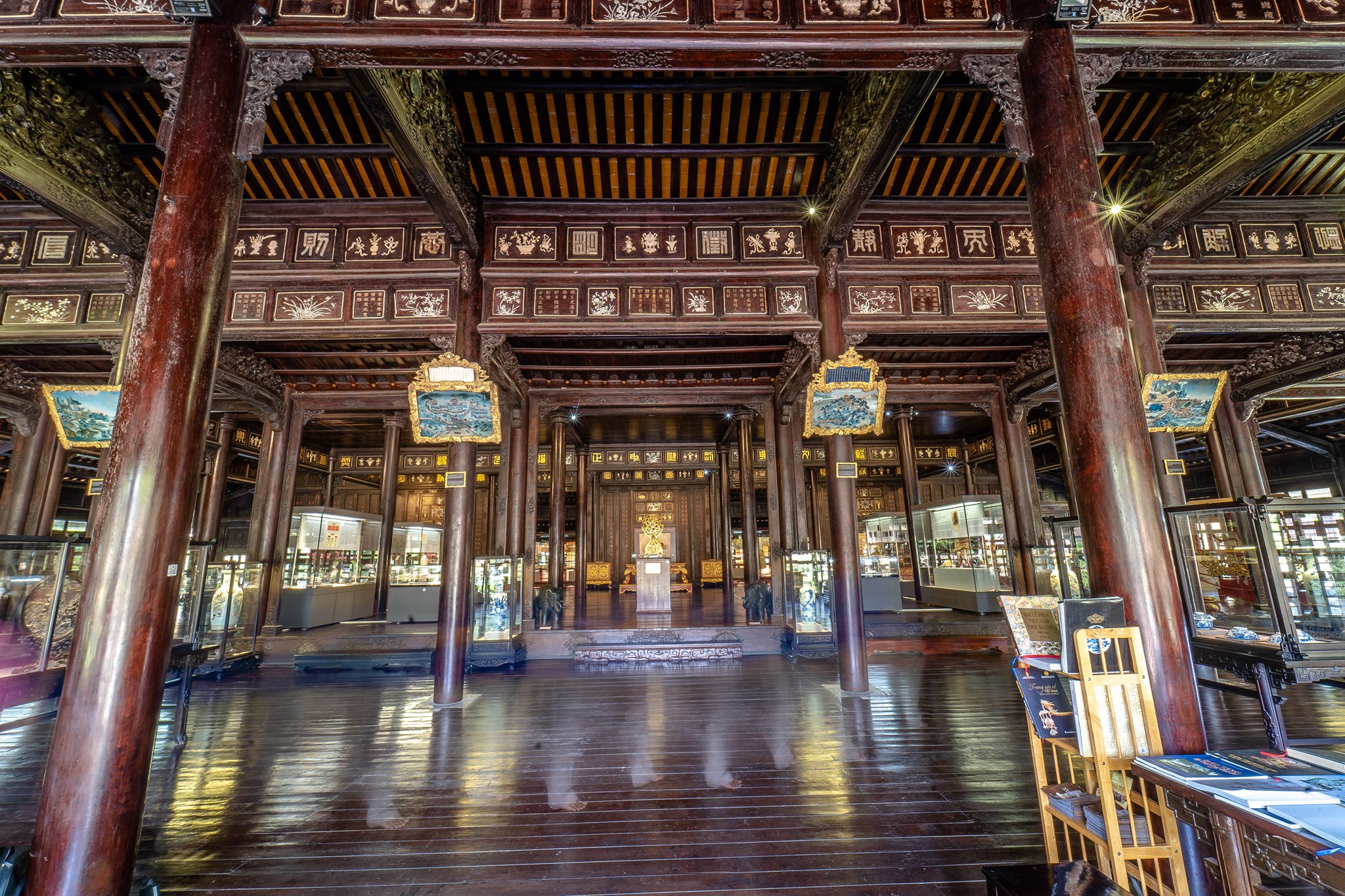
As noted above, Hue mirror paintings are currently displayed and preserved in numerous locations, although historically they were artworks found exclusively within the royal court. Within the heritage complex, surviving mirror paintings are presently located at the following sites: the Hue Museum of Royal Fine Arts (the Long An Palace exhibition space and storage facilities), Dien Tho Palace (main hall), Minh Mang Tomb (Sung An Hall), Thieu Tri Tomb (Bieu Duc Hall), Tu Duc Tomb (Hoa Khiem Hall and Luong Khiem Hall), Duc Duc Tomb (Long An Hall), Dong Khanh Tomb (Ngung Hy Hall), and Hue Nam Palace.
Beyond the heritage sites, Hue mirror paintings are also held at the History Department of Hue University of Sciences and in private collections, notably that of Trần Đình Sơn (Ho Chi Minh City). A detailed inventory is presented below.
1. Hue Museum of Royal Fine Arts
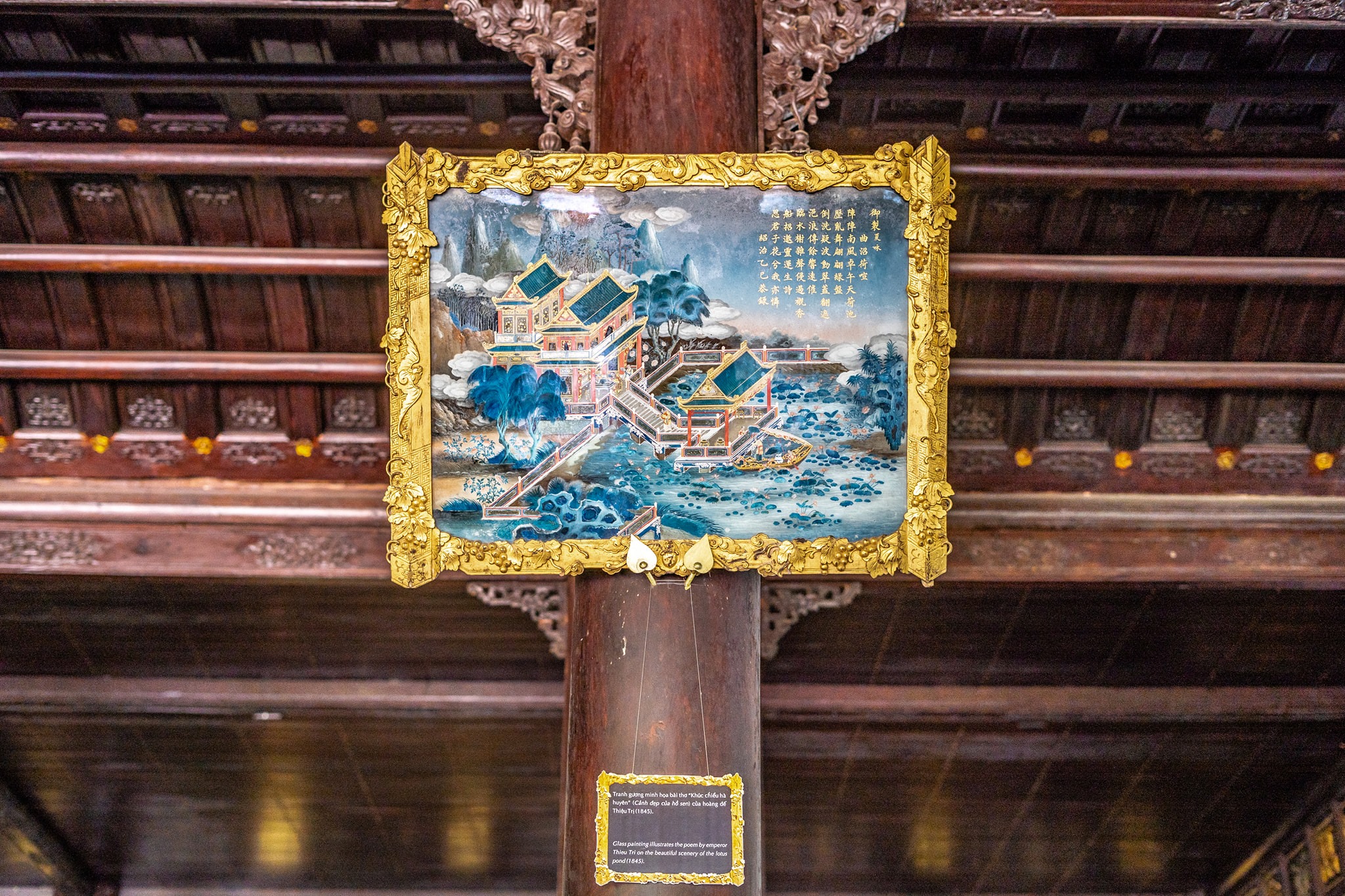
The museum houses a total of 19 mirror paintings. Of these, six works are displayed at Long An Palace, mounted on the rear row of columns in the thừa lưu section—the transitional space between the main hall and the front hall. All six are mirror paintings inscribed with imperial poems. From left to right, they are:
Đình Trừ Xúc Cúc (Strolling among chrysanthemums by the terrace)
Sào Chi Miệt Tước (Sparrows nesting on the branches)
Vĩnh Thiệu Phương Văn (Enduring transmission of fragrance)
Sơn Tủng Tùng Đình (A pine pavilion amid lofty mountains)
Khúc Chiểu Hà Huyên (The song of the lotus)
Yến Lược Không Lương (Swallows darting over bare branches)
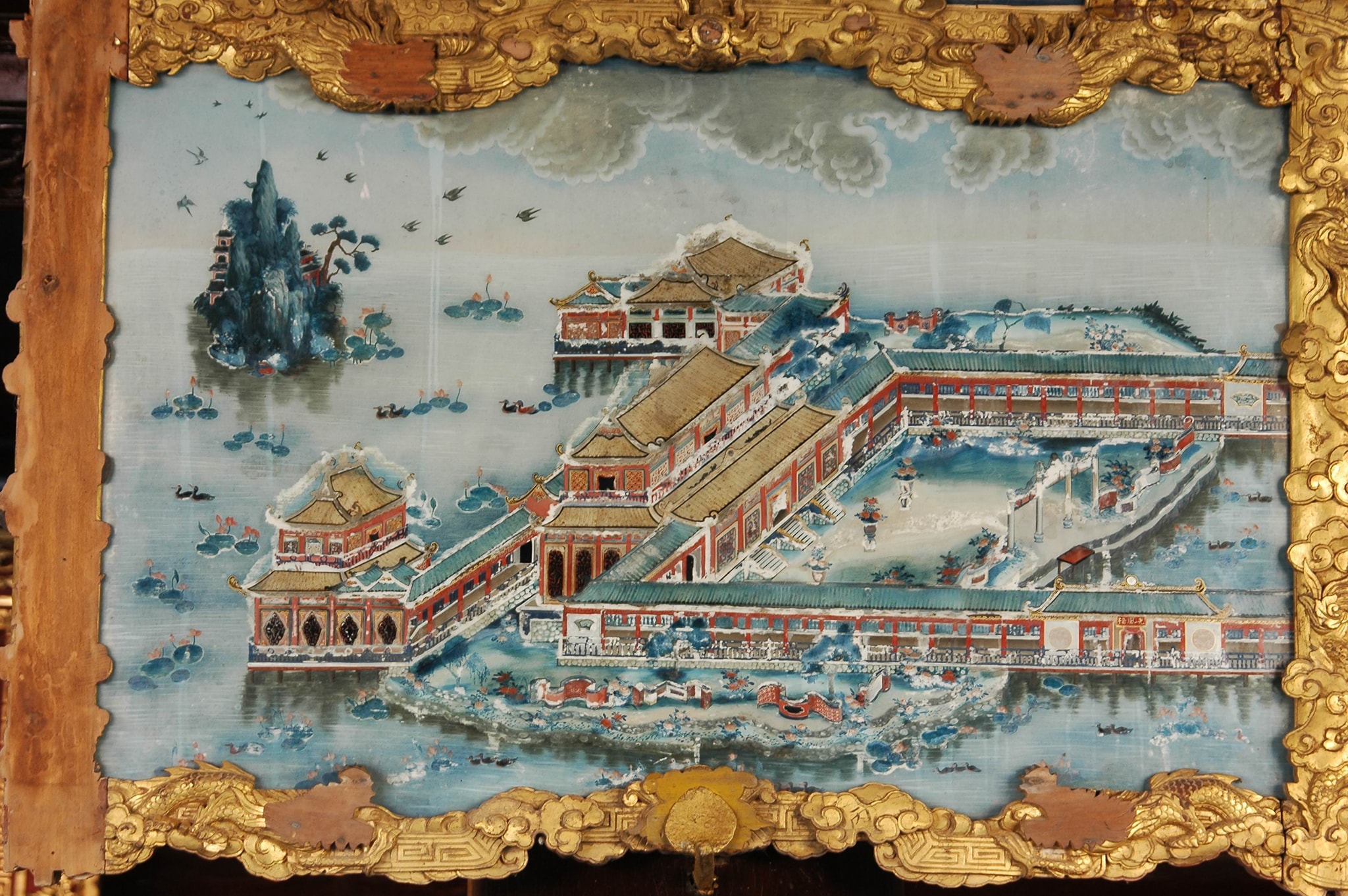
In addition, the museum’s storage facilities contain 13 other mirror paintings, of which nine retain only their frames, while the remaining four are severely deteriorated. Among these, two works are of particular note: Trùng Minh Viễn Chiếu (Two radiant luminaries shining eternally) and a small landscape painting titled Cao Các Sinh Lương. Both are imperial poetry-and-painting compositions inspired by scenes from the Twenty Scenic Views of the Imperial Capital (Thần kinh nhị thập cảnh).
It should also be noted that several months ago, those paintings in relatively better condition were restored and subsequently reinstalled for display in the main hall of Dien Tho Palace.
2. Dien Tho Palace
At present, eight mirror paintings are displayed in the main hall of Dien Tho Palace. These works were transferred from the storage of the Hue Museum of Royal Fine Arts following the restoration of the palace. Viewed from inside looking outward, the eight paintings are mounted on two rows of columns, arranged from left to right as follows:
Outer Row
1. Thiên Mụ Chung Thanh
(The resonant bell of Thiên Mụ Pagoda)
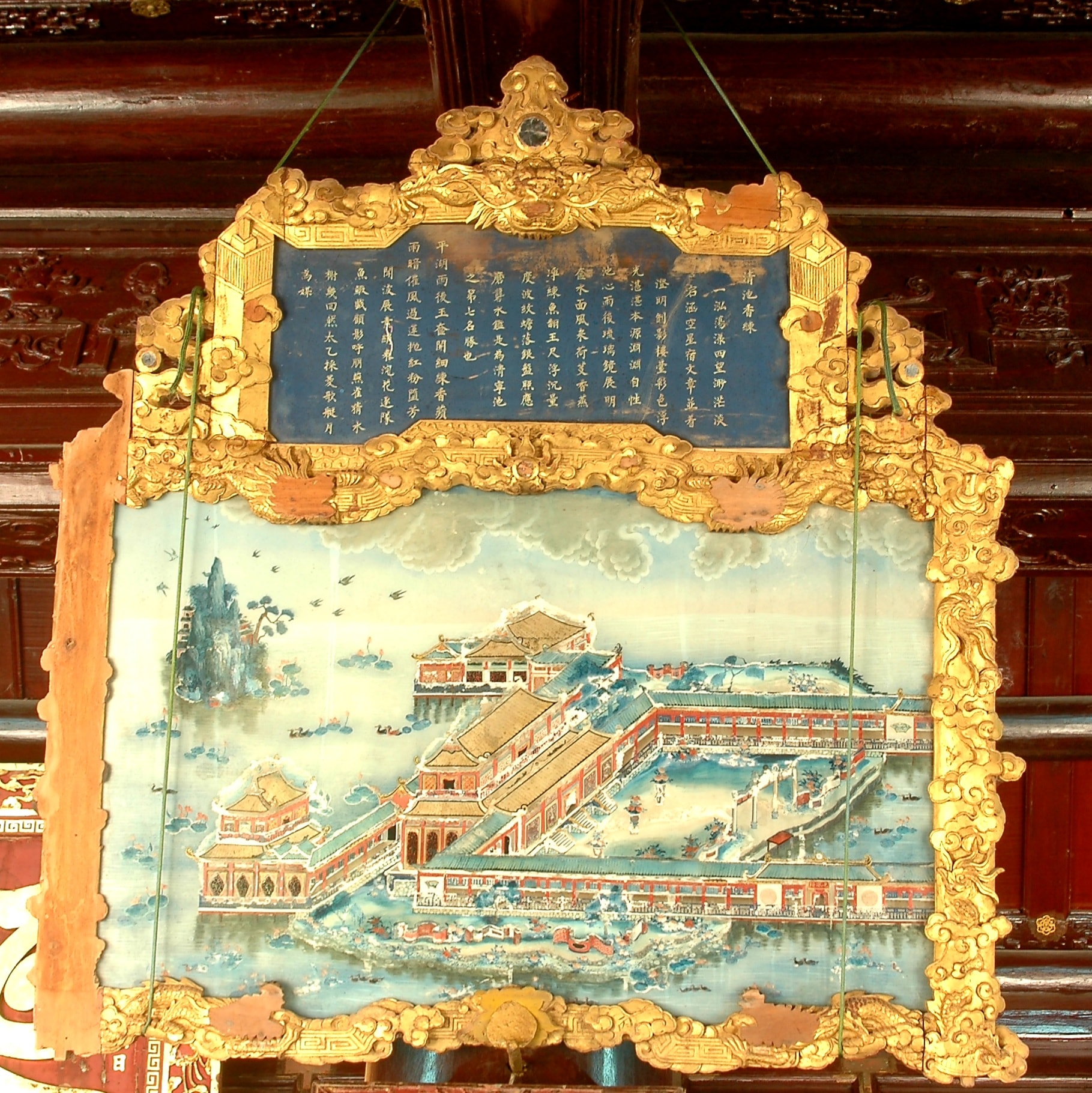
2. Thanh Trì Hương Luyện
(Fragrant incense over the clear pond)
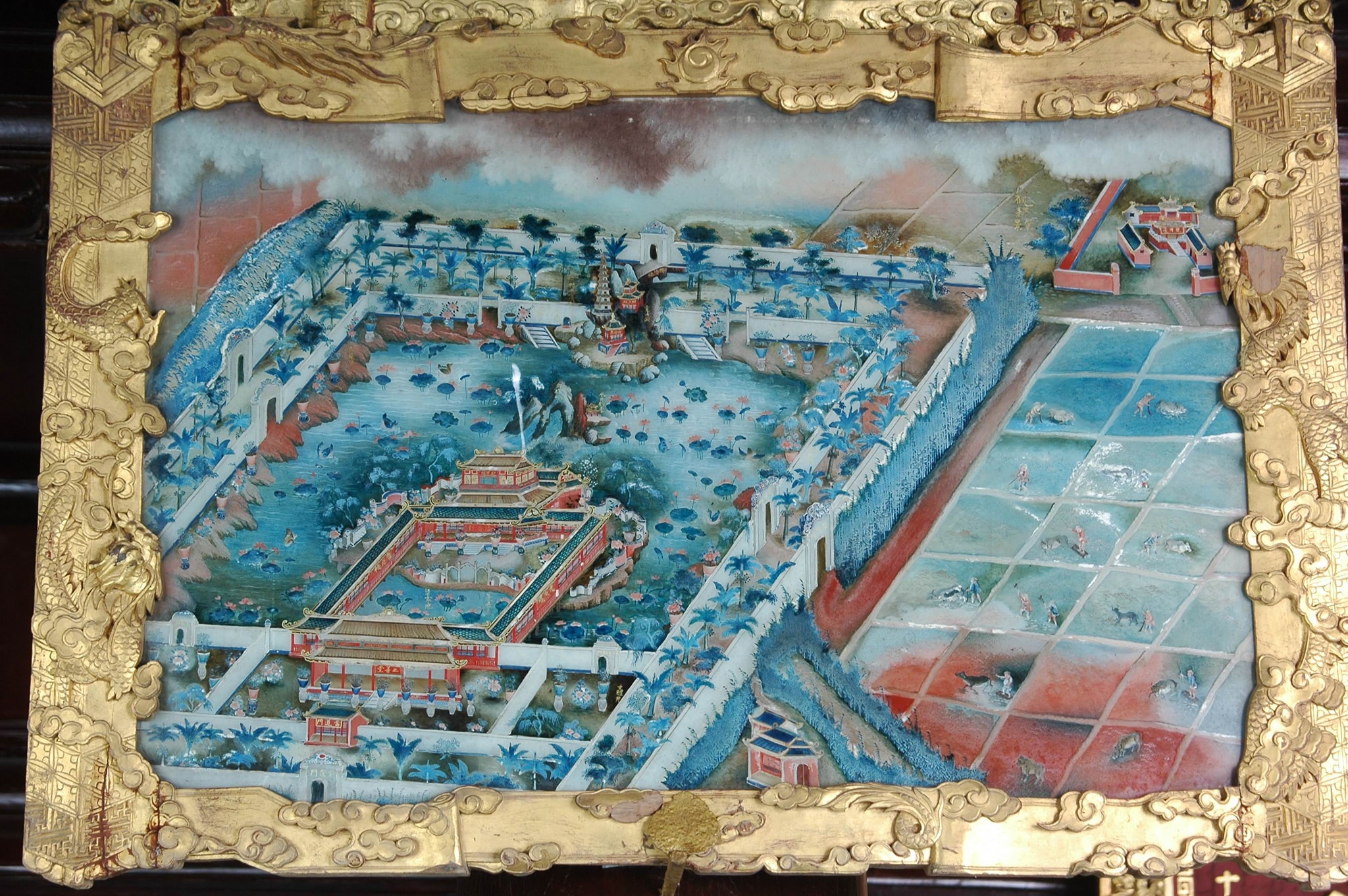
3. Thường Mậu Quan Canh
(Ever-green fields seen in cultivation)
4. Hàn Chung
(The distant, solemn bell)
Lower Row
5. (Inscription missing)
(—)
6. Hiên Sinh Thi Tứ
(Poetic inspiration arising in the pavilion)
7. Cao Các Sinh Lương
(Coolness arising from the lofty pavilion)
8. (Inscription missing)
(—)
3. Tu Duc Tomb
A total of 24 mirror paintings are currently preserved at Tu Duc Tomb, displayed in Hoa Khiem Hall and Luong Khiem Hall.
Hoa Khiem Hall
Sixteen paintings are mounted on three rows of columns:
Outer columns (Front Hall): six paintings
Set 1
1. Liên Tạ Hương Phong
(Lotus fragrance carried on the breeze)
2. Hàn Giang Điếu Đĩnh
(Fishing boats on the cold river)
3. Hồ Già
(The aged lake)
4. Hoa Âm
(Echoes of flowers)
5. Thọ Sắc
(The hues of longevity)
6. Giang Luyện
(The river refined like silk)
Middle row: six paintings
Set 2
1. Ba Tâm
(Threefold harmony of the heart)
2. Thiền Cầm
(Meditative music of the zither)
3. Nguyệt Ảnh
(Moonlight reflections)
4. Tam Thỉ Tiêu Thương
(Three arrows of sorrow)
5. Cúc Ngạo
(The proud chrysanthemum)
6. Nông Lạc
(Joy in rural labor)
Inner columns (Main Hall): four paintings
1. Sơn Quang
(Mountain light)
2. Mai Đình Thận Vũ
(A plum-blossom pavilion bathed in gentle rain)
3. Thú Địch
(The pleasure of the bamboo flute)
4. Hiểu Quan Viễn Tụ
(Morning light gathering over the distant pass)
Luong Khiem Hall
Eight paintings remain (originally twelve; four have been lost, with nail marks still visible on the columns), displayed on three rows of columns:
Front of the Fore Hall (Tiền điện) – 4 panels
Left 1 (Tả nhất): Vũ Hậu Hồng Đường (Thiệu Trị Ất Tỵ cung lục)
(Red halls glistening after the rain)
Right 1 (Hữu nhất): Không Sơn Sấu Cốt
(Gaunt rocks in the empty mountains)
Left 2 (Tả nhị): Nhậm dụng tam kiệt (no inscription)
(Employing the three outstanding talents)
Right 2 (Hữu nhị): Ngộ vật giáo chức (no inscription)
(Moral instruction through understanding things)
Inner Columns of the Fore Hall (Tiền điện) – 2 panels
(Originally 4 panels)
Left side: Chiêu nho giảng kinh (no inscription)
(Summoning scholars to expound the classics)
Right side: Dạ phân giảng kinh (no inscription)
(Expounding the classics at midnight)
Inner Columns of the Main Hall (Chính điện) – 2 panels
(Originally 4 panels)
Left side: Ngự chế đông vịnh – Ngư dược tình ba
(Imperial winter verse: Fish leaping amid clear waves)
Right side: Đương cường hạng lệnh (scene painting)
(Upholding firm discipline and authority)
4. Thieu Tri Tomb
A total of 23 mirror paintings are preserved, including:
17 still-life paintings depicting Bát Bửu Cổ Đồ (Eight Treasures of Antiquity), measuring approximately 74 × 94 cm
(15 displayed, 2 temporarily stored in the corner of the hall)
Four large compartmentalized decorative mirror paintings:
Two mounted on the side gable walls, measuring 1.93 × 2.33 m, each divided into 12 panels (6 floral-and-fruit panels and 6 poetic inscriptions)
Two mounted on the rear wall, measuring 2.1 × 2.3 m, with vertical parallel couplets on both sides and a central section divided into three rows of five panels each, including poetic inscriptions and Bát Bửu motifs
Two poetic mirror paintings displayed in the main hall:
Left: Imperial Spring Poem – Ngư Liễm Liệt Đông (Fishermen drawing in their nets amid winter chill)
Right: Imperial Spring Poem – Cửu Cù Xa Mã (Carriages and horses thronging the nine crossroads)
Note: All poetic mirror paintings are dated “Imperial Record of Thieu Tri, Year of 1845)”.
Four Large Mirror Paintings at Bieu Duc Hall
Left bay, gable wall:
Six poems divided into eleven poetic sections
(After poem no. 10: Imperial poems of Minh Mang, Year of Yi Mui, 1835)
Left bay, rear wall:
Seven poems (poem no. 13 missing), all eight-line poems
(After poem no. 15: Imperial poems of Thieu Tri, Year 1843)
Right bay, rear wall:
Three parallel couplets and six poems
(After poem no. 30: Imperial poems of Thieu Tri, Year 1843)
Right bay, gable wall:
Six mirror paintings (nos. 31–36)
(After painting no. 34: Imperial poems of Thieu Tri, third year, auspicious month, 1843)
5. Faculty of History, Hue University of Sciences
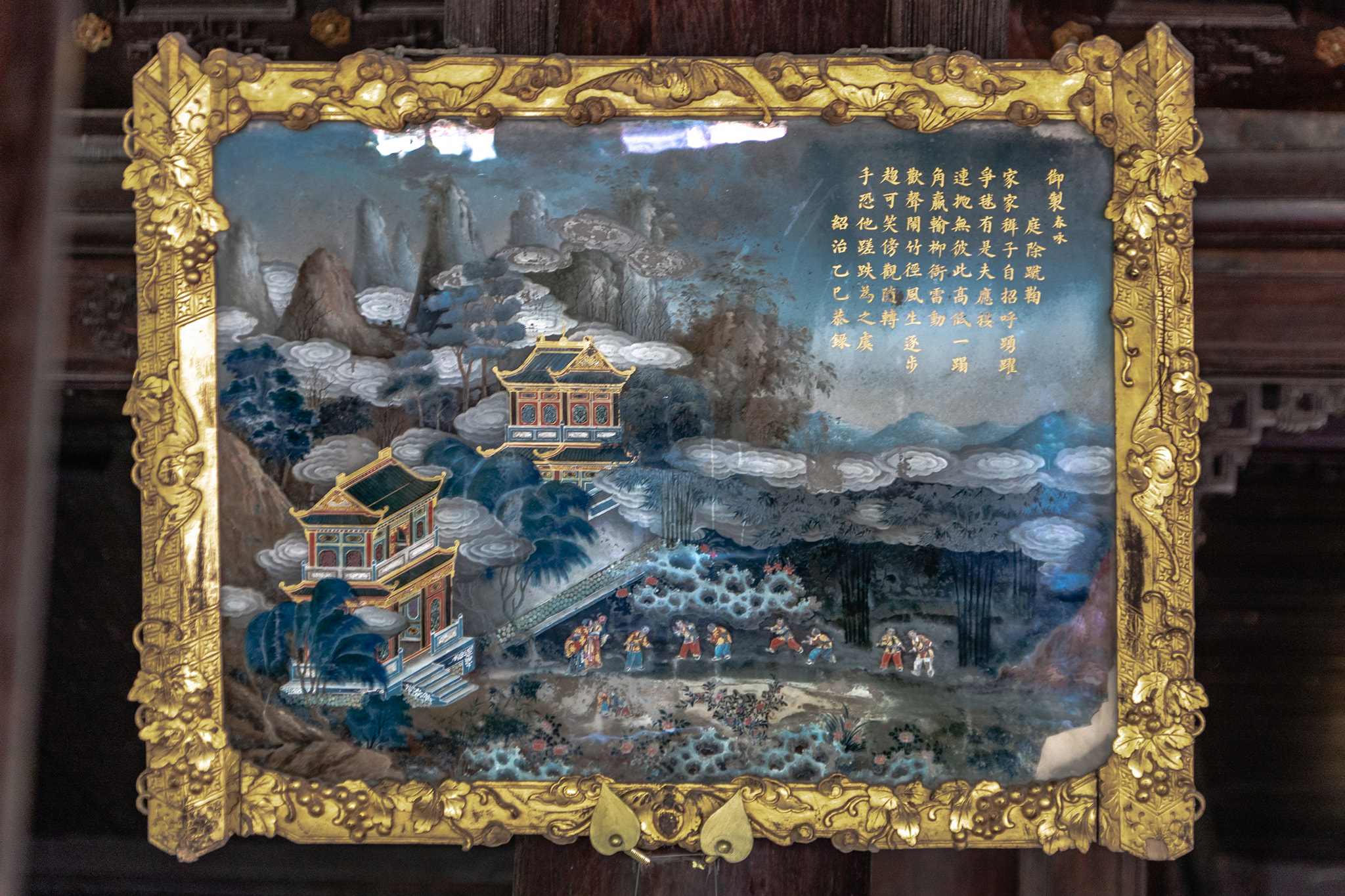
Two poetic mirror paintings:
Lang Tập Quần Phương
(Fragrant blossoms gathered in abundance)
Trì Lưu Liên Phảng
(Lotus fragrance lingering over the pond)
Both are dated Thieu Tri, Year 1845.
6. Minh Mang Tomb (Sung An Hall)
Currently displays mirror paintings depicting still-life subjects (Bát Bửu Cổ Đồ), without poetic inscriptions.
7. Hue Nam Palace (Hon Chen Temple)
Two mirror paintings remain in the inner sanctuary; however, due to prolonged exposure to incense smoke, the inscriptions are no longer legible.
Additionally, the painting of the Seven Principal Disciples of the Holy Mother was removed from a mirror-painting frame to mount a paper painting in its place.
8. Dong Khanh Tomb (Ngung Hy Hall)
Ten mirror paintings are currently preserved, all depicting Bát Bửu Cổ Đồ still-life compositions. The site also retains glass lanterns with square cylindrical forms, inscribed with poems; when illuminated, the poems become clearly legible.
9. Private Collection
According to researcher Tran Dinh Son, he previously owned a mirror painting depicting still-life subjects similar in style to those displayed at Dong Khanh Tomb.
II. Origins, Themes, and Cultural Value of Hue Royal Court Mirror Paintings
II.1. Origins
According to Thai Van Kiem, author of The Ancient Capital of Hue—a view also echoed in oral accounts passed down by elderly residents of Hue—royal court mirror paintings are believed to have originated in China. During the reign of Emperor Thieu Tri (1841–1847), the emperor composed a collection of poems entitled Thần Kinh Nhị Thập Cảnh (Twenty Scenic Views of the Imperial Capital), celebrating twenty renowned landscapes of Hue. These poems were reportedly sent to China, where they were rendered into mirror paintings, each poem corresponding to a single painting. The finished works were then brought back to the imperial capital of Hue and installed in palaces and temples.¹
However, Chu Quang Tru offers a more nuanced assessment. He argues that while the above account is generally credible, it does not fully correspond to the actual number of mirror paintings currently extant, even within temple interiors. Based on comparative study, Professor Chu identifies three distinct sources of origin for Hue mirror paintings:
The first group consists of mirror paintings closely associated with imperial poems bearing explicit dates such as “Thieu Tri, Year 1845". These works were commissioned by the Hue court and produced in China. They represent the most refined and prestigious category, and are considered high-grade artworks.
The second group comprises mirror paintings without poetic inscriptions but bearing thematic titles, largely illustrating episodes from Chinese historical and literary narratives—such as Nhậm Dụng Tam Kiệt (Employing the Three Talents), Chiêu Nho Giảng Kinh (Summoning Scholars to Lecture on the Classics), and Dạ Phân Giảng Kinh (Lecturing on the Classics at Night). These works, now displayed at Thieu Tri Tomb and Tu Duc Tomb, also originated in China. Professor Chu suggests that these paintings were mass-produced by Chinese artisans, sold commercially, and purchased by Nguyễn-dynasty diplomatic missions during their visits to the Qing court.³
The third group consists entirely of still-life mirror paintings, currently displayed at Minh Mang Tomb and Dong Khanh Tomb. According to Professor Chu, these works appear to be imitative imports or locally inspired reproductions. He suggests that they were likely executed by Vietnamese artisans at the turn of the twentieth century, who had not yet fully mastered the techniques of mirror painting.⁴
In contrast, in discussions with us, Nguyen Huu Thong, author of Nguyen Dynasty Art in Hue, asserts that all Hue royal court mirror paintings originated in China, having been commissioned by the Nguyễn court from folk mirror-painting workshops in southern China (the Lingnan region).
We are inclined to support the view that the origins of Hue royal court mirror paintings lie in China; however, the modes and phases of their introduction into Vietnam warrant further examination. Beyond the three categories proposed by Professor Chu, there remain certain paintings—or painting formats—whose provenance raises additional questions. A notable example is the group of highly distinctive mirror paintings adorning Bieu Duc Hall at Thieu Tri Tomb, previously described in the inventory section.
This group consists of four large compartmentalized mirror paintings. Two are mounted on the lateral gable walls, measuring approximately 1.93 × 2.33 meters, each divided into twelve panels—six depicting floral and fruit motifs, and six bearing poetic inscriptions. The remaining two are affixed to the rear wall, measuring 2.1 × 2.3 meters. These feature vertical parallel couplets on both sides, while the central section is subdivided into three horizontal rows of five panels each, including two poetic panels and three still-life panels, all themed around Bát Bửu Cổ Đồ (the Eight Treasures of Antiquity).
A shared characteristic of these four works is their modular composition: individual paintings and poetic panels are framed separately within wooden borders, creating visual segmentation. Yet when viewed as a whole, each composition achieves a remarkable sense of unity, exemplifying a distinctive synthesis of poetry and painting (thi họa – họa thi).
Significantly, the imperial poems inscribed on these works bear earlier dates than those commonly found on standard poetic mirror paintings. Some are dated as early as 1835 (Minh Mang, Year of Yi Mui), while others date to 1843 (Thieu Tri, Year of Quy Mao)—preceding the more familiar 1845 (Thieu Tri, Yi Ty) mirror paintings.
This raises a critical question: were these mirror paintings produced in China, or were they executed locally in Hue? If one were to argue for domestic production, based on similarities in color palette and painterly quality with the still-life mirror paintings that Professor Chu attributes to Vietnamese artisans, a contradiction emerges. The dates of these works are simply too early—preceding even the poetic mirror paintings known to have been commissioned from China—leaving no established prototypes for Vietnamese artisans to imitate.
For this reason, the interpretation offered by Nguyen Huu Thong appears more persuasive: namely, that all mirror paintings were initially produced in China, and that poetic inscriptions were added only after their arrival in Hue.
It should also be noted that at Ngung Hy Hall of Dong Khanh Tomb, several glass panels are framed within lanterns. These may be regarded as a variant of mirror painting, as their technique is identical—poems and images executed directly onto glass using reverse-painting methods. Their primary function, however, was decorative: when illuminated, the poems become clearly legible. This particular form of mirror painting likely dates to the late nineteenth or early twentieth century.
II.2. Thematic Content and Artistic Value of Hue Royal Court Mirror Paintings
The thematic content of Hue royal court mirror paintings can, in broad terms, be classified into three principal categories, largely corresponding to the typology proposed by Chu Quang Tru.
1. High-grade “Poetry-and-Painting” Works (Imperial Poetic Mirror Paintings)
This category comprises landscape paintings accompanied by imperial poems (thi họa). Based on current documentation, approximately forty works of this type remain in relatively intact condition in Hue. They may be further subdivided as follows:
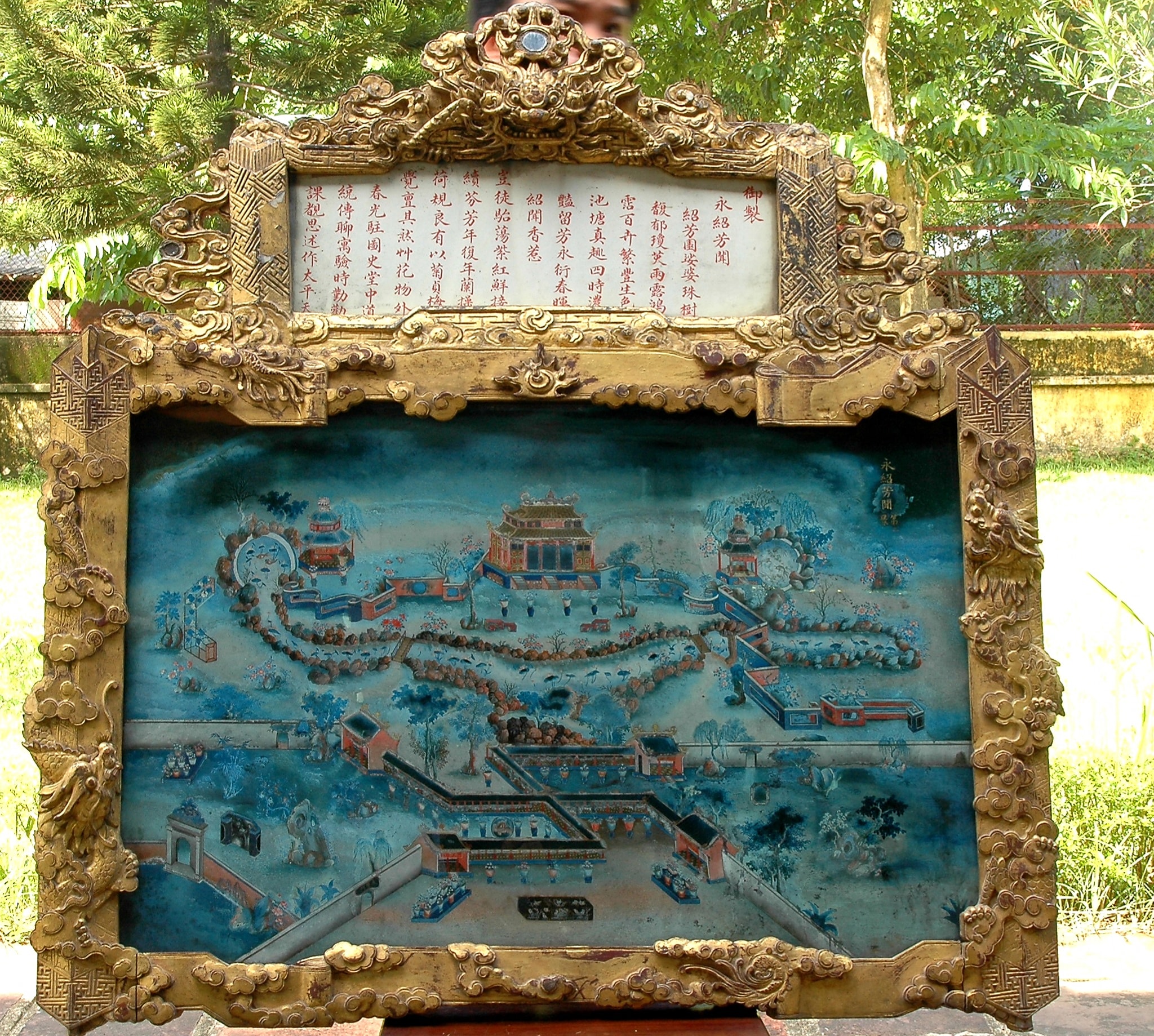
Paintings celebrating scenic landscapes of the Imperial Capital, primarily depicting the Twenty Scenic Views of the Imperial Capital (Thần Kinh Nhị Thập Cảnh) as ranked by Emperor Thiệu Trị, though several works illustrate scenes beyond this canonical list. Representative examples include Trùng Minh Viễn Chiếu, Vĩnh Thiệu Phương Văn, Thiên Mụ Chung Thanh, Thường Mậu Quan Canh, Cao Các Sinh Lương, and Lang Tập Quần Phương.
The central theme of these paintings is the visual evocation and poetic praise of Hue’s landscapes, in direct correspondence with the accompanying imperial verses. Notably, the mirror paintings do not merely illustrate the twenty principal poems, but also render clusters of subsidiary poems that describe secondary or intimate views associated with each of the twenty scenes.
Paintings illustrating poems on the seasons and spontaneous poetic compositions, inspired by momentary impressions of nature—such as Hàn Chung, Giang Luyện, Sơn Quang, and Nguyệt Ảnh. While the subject matter varies, the pictorial techniques and color schemes of this group remain largely consistent.
As observed by scholars, these paintings predominantly employ a cool color palette: landscapes and architectural elements are rendered in shades of blue and green; clouds and skies appear in pale bluish-white tones; structural columns are painted in red, with gold outlining. The compositions are meticulously detailed, with subtle gradations of color and finely articulated figures. Spatial organization follows a psychological rather than naturalistic perspective, reversing conventional depth cues.
The painters—imagining the imperial poems through the lens of the temperate or colder environments in which they lived—executed these works in a highly refined gongbi (fine-line) style. Technically, the paintings were created directly on the reverse side of glass using a reverse-painting (negative) technique: outer colors were applied first, inner layers followed, and the background was painted last. The pigments are notably durable, retaining their original brilliance to this day.⁶
2. Narrative Mirror Paintings without Poetic Inscriptions
The second category consists of mirror paintings without accompanying poems, but bearing clearly defined thematic titles. These works primarily illustrate well-known historical and literary episodes from Chinese history, such as Nhậm Dụng Tam Kiệt (The Han Founder Employing Three Talents), Chiêu Nho Giảng Kinh (Summoning Scholars to Lecture on the Classics, associated with Emperor Xuan of Han), and Dạ Phân Giảng Kinh (Lecturing on the Classics at Midnight, associated with Emperor Guangwu of Han).
Regarding technique, Professor Chu Quang Trứ notes that although these paintings are executed with less precision than the imperial poetic works, they remain carefully detailed. They tend to favor warm red tones, though less refined pigment preparation has resulted in discoloration and staining in certain areas over time.⁷
3. Still-Life Mirror Paintings
The third category is devoted exclusively to still-life subjects, focusing on two principal themes: Bát Bửu Cổ Đồ (the Eight Treasures of Antiquity) and arrangements of fruits and flowers. Contrary to Professor Chu’s more reserved assessment, several Hue-based researchers have expressed high regard for the artistic quality of these works.
The presence of Nguyen-period still-life mirror paintings is evidenced by ten mirror paintings measuring approximately 50 × 60 cm, mounted on the outer columns of the main hall at Dong Khanh Tomb. Their motifs include vases of fruits, censers, inkstones, and scholarly implements, placed upon pedestals of varied forms and framed by geometric border patterns. The color schemes are rich and varied: backgrounds may appear in incense-smoke hues, sky blue, or deep black, against which the vermilion red of the stands and the jade green of the vessels stand out vividly.
These chromatic contrasts lend each still-life painting a sense of splendor tempered by understated elegance—an aesthetic quality both radiant and quietly refined.
III. Concluding Reflections
As discussed above, despite being a highly distinctive art form that embodies the unique identity of Nguyen-dynasty court art in Hue, royal court mirror painting has yet to receive commensurate scholarly attention or systematic investment in conservation. In the immediate future, we believe that the following measures should be undertaken with determination:
1. Exhibition and Display
At present, the display and storage of mirror paintings across heritage sites remain rather disorganized. It is therefore essential to reorganize and re-exhibit these works according to coherent thematic groupings—for example, paintings illustrating the Twenty Scenic Views of the Imperial Capital, or those celebrating the four seasons. Even still-life paintings depicting Bát Bửu (the Eight Treasures) and floral or fruit motifs should be displayed in a more rational and aesthetically integrated manner.
2. Periodic Thematic Exhibitions
During major cultural events and festivals—such as the Hue Festival—it would be highly desirable to curate a dedicated exhibition of Hue mirror paintings, selected from the surviving works currently preserved in the city. Alongside royal court mirror paintings, folk mirror paintings should also be included to create a meaningful dialogue between the two traditions and to enrich the exhibition’s visual and cultural diversity. Such a distinctive exhibition would undoubtedly attract considerable attention from art enthusiasts, especially given that the range of traditional art forms currently accessible to visitors in Hue remains far more limited than the city’s historical legacy would suggest.
3. Conservation and Restoration
At present, the institution managing the largest number of mirror paintings—the Hue Monuments Conservation Centre—has made initial efforts to restore several deteriorated works for re-display. However, these efforts have yet to yield fully satisfactory results. This situation is deeply concerning, as a significant number of highly valuable mirror paintings remain in a state of severe degradation without adequate intervention.
The most urgent priority, therefore, is sustained investment in research aimed at recovering and revitalizing the techniques of restoration and conservation specific to this unique art form. Although such work is undoubtedly challenging, it remains feasible. Today, cultural and technical exchanges with southern China—a region historically renowned for its mirror-painting craftsmanship—have become far more accessible. Moreover, within Vietnam itself, a small number of folk mirror-painting workshops still survive, albeit producing works of considerably more modest quality than the royal court paintings discussed here. Studying the origins and techniques preserved in these contexts may provide valuable insights for the conservation and revival of Nguyen-dynasty court mirror painting techniques.
Notes
(1, 2, 3, 4, 6, 7). Mỹ thuật Huế (Hue Fine Arts), Institute of Fine Arts – Hue Monuments Conservation Centre, pp. 107–109.
(5). To date, we have identified five mirror paintings depicting four principal scenes from the Twenty Scenic Views of the Imperial Capital. In addition, according to researchers Nguyễn Đình Hòe and L. Cadière, in their article “Quelques coins de la Citadel de Hué” published in B.A.V.H., no. 3 (1922), two mirror paintings depicting Tinh Tam Lake were formerly displayed in Can Chanh Palace. One illustrated Tinh Hồ Hạ Hứng (the third scenic view), while the other depicted a subsidiary scene of Tinh Tam Lake associated with the poem Oanh Đê Xuân Sắc, part of Emperor Thiệu Trị’s fifteen-poem cycle on this site. Regrettably, both paintings appear to have shared the fate of Can Chanh Palace and were likely destroyed entirely in early 1947.
Mỹ thuật thời Nguyễn trên đất Huế (Art of the Nguyen Dynasty in Hue), Writers’ Association Publishing House, p. 167.
(9). Folk mirror paintings likely emerged during the Nguyen dynasty and primarily served popular religious and ritual needs. They were also used for domestic decoration, temples and communal houses, and as gifts for housewarmings, weddings, and celebratory occasions. Historically, such paintings were produced in villages including Tien Non, Dia Linh, and Bao Vinh, and distributed inland via the Thanh Ha–Bao Vinh trading port. Their subjects ranged from landscapes to episodes from classical literature such as Romance of the Three Kingdoms, Water Margin, The Tale of Kieu, and Luc Van Tien, with particular emphasis on still-life themes like the Four Seasons, pine and deer, chrysanthemum and butterfly, peony and pheasant. Today, only a few households in Bao Vinh and Tien Non continue this tradition.
According to Phan Thanh Hai