menu_open

Kham Thiem Giam - The Imperial Observatory of the Nguyen Dynasty

View font:
Explore the only century-old 'meteorological observatory' left in Vietnam, home to mysterious star maps recently unveiled after being hidden for nearly a century beneath the lime crust of time.

Introduction:

Amidst the serene and contemplative atmosphere of the Hue Citadel, the Imperial Observatory (Kham Thien Giam) was not merely an administrative office, but a symbol of the pinnacle of scientific knowledge during the Nguyen Dynasty. It stands as the only surviving institution in Vietnam that specialized in astronomy, calendaring, and hydrometeorology.

After decades of enduring harsh weather conditions and the ravages of war, the Nguyen Dynasty's Imperial Observatory has officially entered a new chapter. On April 26, 2026, it was designated as a National Historical Relic by the Ministry of Culture, Sports, and Tourism under Decision No. 321/QD-BVHTTDL. This recognition is not only a legal affirmation but also a poignant reminder of a "sacred observatory" that once regulated the daily rhythm of life for the entire nation for over a century.

Current State & Value: Today, although the structure has degraded and relies on a system of iron frames and fences to withstand the elements, the intrinsic values it holds remain fully captivating to those deeply devoted to Hue's cultural heritage.

History:

The Evolution of the Imperial Observatory Through Vietnamese Dynasties

Observing the cosmos to understand the laws of the universe was an inseparable part of the governance philosophy of Vietnamese dynasties. The Imperial Observatory (Kham Thien Giam) of the Nguyen Dynasty represented the culmination and perfection of predecessor institutions spanning several centuries:

  • The Tran and Ho Dynasties: The earliest iteration emerged in the 13th century under the name Thaisucuc (The Bureau of Astronomy). This was an era when brilliant astronomers like Dang Lo crafted the "Linh lung nghi" (an armillary sphere/astronomy instrument) to observe the stars and proposed updating the Thu Thoi calendar to the Hiep Ky calendar.

  • The Early Le Dynasty: In 1471, King Le Thanh Tong renamed the institution Tu Thien giam, asserting its role as a vital organ holding crucial state responsibilities.

  • The Nguyen Lords of Dang Trong (The South): Interest in astronomy was sustained through the Chiêm hậu office, where the Nguyen Lords appointed officials to monitor weather and geography in the newly settled lands.

  • The Nguyen Dynasty (1803): In 1803, immediately after unifying the country, King Gia Long officially established Kham Thien Giam in the Capital. The name "Kham Thien" carries a profound meaning: "Kham" signifies reverence for royal decrees (Kham menh), and "Thien" refers to celestial phenomena and the universe. Initially, the headquarters were located in Nam An ward, near the southwest corner of the Hue Citadel, providing convenient access to the Quan Tuong Dai (The Observatory Tower) for astronomical observations.

  • Relocation (1918): It was not until October 1918, during the reign of King Khai Dinh, that the institution was relocated to its current site at 82 Han Thuyen Street—the former grounds of the Thai y vien (The Royal Physicians' Institute).

Highlight:

The Multifunctional Operations of the Imperial Observatory

Under the Nguyen Dynasty, the Imperial Observatory (Kham Thien Giam) operated as a multidisciplinary research institution, influencing everything from agricultural production to major political rituals.

Crafting the Hiep Ky Calendar – The National "Compass"

The primary mission of the Imperial Observatory was to compile and issue the annual calendar. In 1813, the royal court transitioned to the Hiep Ky Calendar, which was calculated using the Thoi Hien method—a blend of Western and Eastern scientific approaches acquired from the Qing Dynasty by the high-ranking official Nguyen Huu Than. The Hiep Ky Calendar offered vastly superior accuracy compared to the previous Van Toan Calendar, particularly in predicting solar and lunar eclipses.
The Strict Annual Calendar-Making Process:

The calendar creation followed an exceptionally rigorous schedule each year:

  • February: Astronomers began calculating the calendar for the following year.

  • May: The master templates were engraved and sent to remote regions, such as Hanoi and Gia Dinh, for printing.

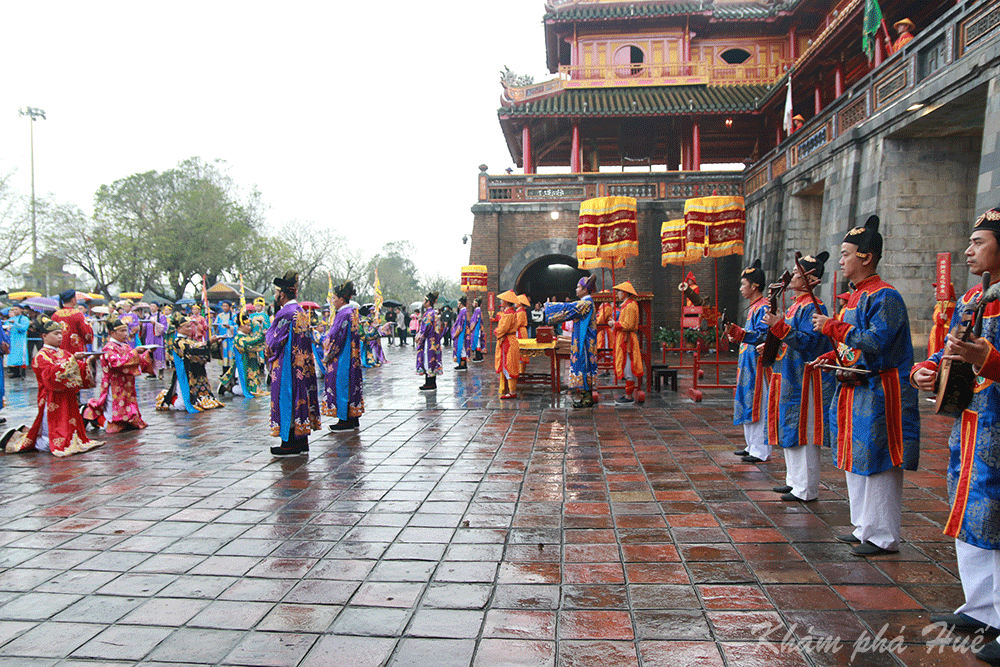
  • December: The grand Ban Soc Ceremony (Calendar Distribution) was held at the Throne Palace (Dien Thai Hoa). Here, the Emperor bestowed the calendar upon his officials and the public, serving as a powerful symbol of the Son of Heaven’s supreme authority over time and his subjects.

Astronomical and Hydrometeorological Observation

At the Quan Tuong Dai (The South Meridian Watchtower), astrologers utilized telescopes to track the stars. A detailed report preserved in the Chau ban (Imperial Archives) of the Nguyen Dynasty, dated the 19th day of the 12th lunar month in the 11th year of Minh Mang's reign (1830), states:

"During the Dan hour (3 AM – 5 AM) today, the Thien Thi Vien constellation (Heavenly Market Enclosure) near the horizon began to be heavily obscured by dense clouds and frost... respectfully noted that from the horizon up to the said constellation, the altitude is 35 degrees."

Aside from astronomy, measuring rainfall was a vital task to support agriculture. The Imperial Observatory (Kham Thien Giam) was required to measure the water accumulated in copper basins and the depth of soil moisture absorption on a daily basis. A royal petition from 1879 explicitly records:

"During the Dau hour (5 PM – 7 PM) on the 19th day, it rained... the accumulated water measured 1 tac and 9 phan (approx. 7.6 cm), and the soil moisture penetration reached 5 tac and 7 phan (approx. 22.8 cm)."

Selection of Auspicious Dates and Geomancy (Feng Shui)

Every major state affair—such as the Nam Giao Sacrifice Ritual, Royal Coronations, the announcement of successful doctoral candidates (the Golden Board), or even selecting imperial burial sites (mausoleums)—fell under the purview of the Imperial Observatory. The officials acted as national-level geomancers, ensuring perfect harmony between humanity and the earth's cosmic currents (mach dat) of the nation.

Institutional Structure and Talent Recruitment Policies

The Nguyen Dynasty's Imperial Observatory was organized with extreme discipline, particularly during the reign of King Minh Mang:

  • Leadership: Headed by the Giam chinh (Director - Principal 5th Rank) and the Giam pho (Deputy Director - Subordinate 5th Rank).

  • Specialized Staff: Included the Ngu quan chinh (Officials of the Five Seasons: Spring, Summer, Autumn, Winter, and Mid-Year) and the Linh dai lang (Observatory Observers who directly monitored the stars from the watchtower).

  • Iron Discipline: The Nguyen Court was exceptionally strict regarding scientific errors. In 1875, top officials of the Observatory were sentenced to 60 strokes of the cane and a one-year salary forfeiture for miscalculating a solar eclipse.

Notably, in 1835, King Minh Mang issued a royal decree confirming a policy to recruit talented individuals regardless of their social background:

"No matter if they are officials or commoners, if anyone possesses knowledge of interpreting celestial phenomena... the higher authorities shall grant them certificates to travel to the Capital for potential appointment."

This demonstrates the dynasty's open-minded perspective and its high regard for specialized expertise.

Architecture:

The current headquarters at 82 Han Thuyen Street deeply reflects the architectural style of the Khai Dinh and Bao Dai eras. Although the original scale of the architecture has been distorted due to more than 50 years of residential encroachment, the monument still retains the fundamental structural components of an imperial government office.

Dismantling and relocating civil structures encroaching upon the Imperial Observatory to restore its historical space.

Current Conditions and Heritage Artifacts

The current state of the relic reveals that the internal partition wall system within the main hall still preserves layers of ancient lime mortar, where former officials directly drew celestial and meteorological maps for their work.

Although the tiled roof has sustained heavy damage, it still retains wooden structural elements intricately carved with figures of the Nghê (a mythical Vietnamese guardian creature). However, these structures are now severely rotted and require urgent conservation.

The Imperial Observatory monument is currently in a state of severe degradation and is being actively restored by the Hue Monuments Conservation Center.

Nguyen Dynasty Royal Tombs map discovered beneath old whitewash at the Imperial Observatory.​

Artistic Value:

The Wall Paintings: The Pinnacle of Artistic and Scientific Value

The greatest artistic value of the Imperial Observatory lies in the recently unveiled wall paintings, which were applied directly onto the plaster:

  • The Bagua Celestial Chart (Star Map): A large wall featuring constellations depicted in the form of a "Bagua" (Eight Trigrams) diagram, accompanied by meticulous Classical Chinese (Chu Han) annotations. This represents an invaluable operational document that offers a vivid glimpse into how ancient astronomers mapped and managed the night sky. The delicate yet highly precise brushstrokes demonstrate the exceptional aesthetic mindset and superior scientific proficiency of the Imperial Observatory officials.

  • A meticulously detailed star map painted directly on the wall at the Imperial Observatory in the form of a 'Bagua' (Eight Trigrams) diagram.

The Imperial Mausoleums Topographical Map: This mural features the inscription "Phung hoi chu ton lang dia do, phu thuoc toan do" (The Imperial Map of Royal Mausoleums and Subordinate Territories, Compiled and Inscribed with Reverence), delineating the precise locations of the Nguyen Dynasty's royal tombs. The practice of painting this map directly onto the wall underscores the chamber's function as a geographical and geomantic "war room" or tactical operations center.

  • A Human Resource Training Center: The Imperial Observatory also functioned as a specialized "university." A regulation issued in 1856 explicitly outlined a three-year curriculum: the first year was dedicated to studying the Hiep Ky calendar; the second year focused on the That Chinh (Seven Luminaries) calendar; and the third year covered the computation of solar and lunar eclipses, as well as the selection of auspicious dates and times.

  • Cultural Intersection: French characters appear on the murals alongside Classical Chinese (Chu Han) and Vietnamese (Chu Quoc Ngu). This serves as tangible evidence of historical transitions and the intersection of Eastern and Western knowledge during the early years of the 20th century.

A One-of-a-Kind Heritage to be Revitalized

It is precisely these celestial charts that make the Imperial Observatory a "one-of-a-kind" relic in Vietnam. Following its official recognition as a National Relic, a comprehensive restoration project for the 2026–2030 period is currently underway to restore the original architecture and digitalize these priceless documents. Revitalizing the Imperial Observatory is not merely about rescuing an architectural structure; it is a journey to decode the cosmic "ciphers" entrusted by our ancestors to future generations.

Given its stature as a unique scientific institution, its designation as a National Relic in 2026 stands as a testament to its irreplaceable historical and artistic value. The Hue Monuments Conservation Center has already digitalized these topographical murals to support the restoration efforts planned for the 2026–2030 phase.

----------------

REFERENCES

1. Trung tâm Lưu trữ quốc gia I, "Khâm thiên giám triều Nguyễn", Giới thiệu tài liệu - nghiệp vụ - Liên kết: https://archives.org.vn/gioi-thieu-tai-lieu-nghiep-vu/kham-thien-giam-trieu-nguyen.htm
2. Tạp chí Khoa học xã hội, số 11 (231), tr. 27-38, "Cơ quan Khâm Thiên giám qua các triều đại quân chủ Việt Nam", Trương Anh Thuận (2017).
3. Tạp chí Khoa học xã hội, số 1 (269), tr. 54-64,  "Lịch Hiệp Kỷ dưới triều Nguyễn (1802 - 1883)", Trương Anh Thuận (2021).
4. Báo Văn Hóa, "Di tích Khâm Thiên Giám và Phủ Phụ Chính triều Nguyễn được xếp hạng di tích cấp quốc gia" - Liên kết: https://baovanhoa.vn/van-hoa/di-tich-kham-thien-giam-va-phu-phu-chinh-trieu-nguyen-duoc-xep-hang-di-tich-cap-quoc-gia-222678.html
5. Báo Dân trí, "Giải mã bức địa đồ trong di tích Khâm Thiên Giám phát lộ khi dọn vệ sinh" - Liên kết: https://dantri.com.vn/doi-song/giai-ma-buc-dia-do-trong-di-tich-kham-thien-giam-phat-lo-khi-don-ve-sinh-20260127084610123.htm
6. Báo Tuổi Trẻ Online (2018), "Khâm Thiên Giám - cơ quan quan trọng của triều Nguyễn - đang... sập" - Liên kết: https://tuoitre.vn/kham-thien-giam-co-quan-quan-trong-cua-trieu-nguyen-dang-sap-20181019092751299.htm
7. VTC News, "Cảnh đổ nát trong cơ quan khí tượng trăm tuổi của triều Nguyễn" - Liên kết: https://vtcnews.vn/canh-do-nat-trong-co-quan-khi-tuong-tram-tuoi-cua-trieu-nguyen-ar927877.html

Photos: Bao Minh, Ngoc Bich